Getting Started
Bitcoin vs Interac e-Transfer: What Canadian Businesses Are Comparing
A factual comparison of Bitcoin and Interac e-Transfer for Canadian merchants, covering limits, fees, reversal risk, settlement finality, and CRA recordkeeping.
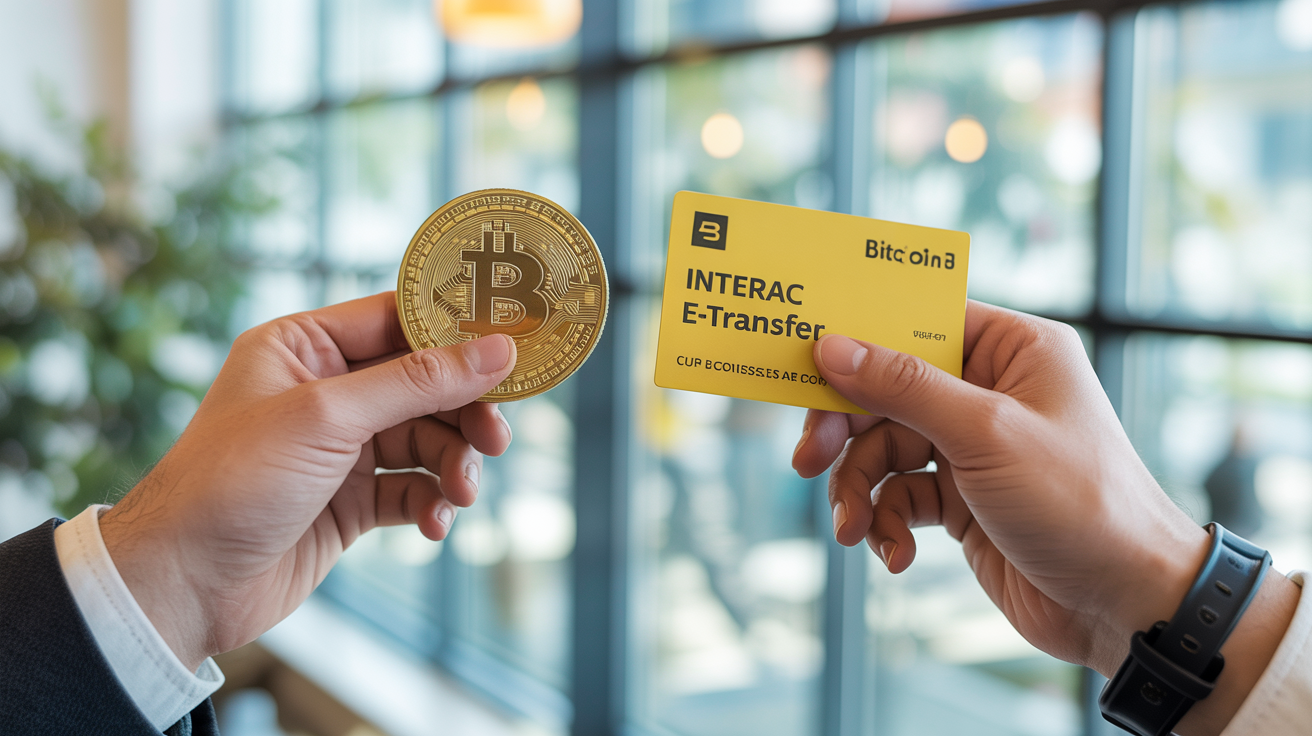
Interac e-Transfer is the payment method most Canadians already know. It runs through the banking system, it requires no card terminal, and for many small businesses it has replaced cheques entirely. Bitcoin is structurally different at almost every level, but the surface similarity is real: both move value directly between two parties, outside the Visa and Mastercard rails.
That surface similarity is exactly why Canadian merchants tend to compare them. Understanding where the two diverge, in practical terms, helps you form an accurate picture of what adding bitcoin actually changes for your business. This article walks through the dimensions that matter most: limits, reversal risk, fees, settlement timing, and the recordkeeping each method demands.
Nothing here is financial, legal, or tax advice. Rules and fee structures change, so verify current details with your bank, processor, and a qualified professional or the CRA before making business decisions.
Transaction Limits and Sending Caps
Interac e-Transfer imposes limits at two levels: the sending bank sets a per-transfer cap, and there is also a daily or weekly maximum. For most personal accounts at major Canadian banks, a single transfer is capped between $2,500 and $3,000. Business accounts can negotiate higher limits, but even then the caps are enforced at the bank level and cannot be overridden by the recipient. A $10,000 invoice paid via e-Transfer almost always requires multiple separate transfers, which adds friction for the payer and reconciliation overhead for you.
Bitcoin has no built-in dollar cap. A transaction for $200,000 worth of bitcoin costs roughly the same in network fees as one for $200. The practical limits are the exchange withdrawal limits a customer faces if they are buying bitcoin specifically to pay you, but that is a customer-side constraint, not a protocol-level one. For high-value B2B transactions, this is one of the clearer practical differences.
For smaller purchases, say, retail items under a few hundred dollars, the limit gap is irrelevant. But for service businesses with invoices in the thousands, the Interac ceiling becomes a real workflow problem.
Reversal Risk and Payment Finality
Interac e-Transfer has a recall mechanism. A sender can request a reversal before you deposit the funds, and in fraud cases the bank may claw back a transfer after the fact. In practice, reversals are relatively uncommon in normal commerce, but they are possible. For businesses that have experienced a fraudulent e-Transfer, the risk is not theoretical.
Bitcoin works differently. Once a transaction has been confirmed on the blockchain, it cannot be reversed by the sender, a bank, a payment processor, or any intermediary. This is often described as "settlement finality." There is no chargeback equivalent, no dispute mechanism that can pull funds back after confirmation.
This distinction matters in different ways depending on the business. A merchant selling digital goods that can be delivered instantly tends to value finality because chargebacks on digital goods are a known fraud vector. A business with a lot of returns or customer disputes may find the irrevocability of bitcoin more complicated to work around, since refunds have to be issued manually rather than through a reversal process.
To understand how confirmation works in practice, see how bitcoin payments work step by step. The number of confirmations needed before a payment is considered final depends on the transaction size and the payment rail being used.
Fees: What Each Method Actually Costs
Interac e-Transfer is often described as free, but the cost is bundled into banking fees. Most personal accounts include a set number of free e-Transfers per month through a flat monthly fee. Business accounts typically pay per-transaction fees ranging from $0.75 to $1.50 per transfer depending on the institution and account tier. There are no percentage-based fees, which makes Interac cost-effective for larger amounts relative to card payments.
Bitcoin fees come in two forms. Network fees (sometimes called miner fees) go to the validators who process transactions; these fluctuate with network congestion. During quiet periods, a typical on-chain transaction costs the equivalent of a few cents to a couple of dollars in bitcoin fees. During peak demand, fees have spiked meaningfully higher for time-sensitive transactions.
The second type is processor fees, charged by any third-party service that handles bitcoin payments on your behalf. These vary by provider, and many include a conversion fee if you want to settle in Canadian dollars rather than hold bitcoin.
For small frequent purchases, the Lightning Network offers near-zero fees and near-instant settlement. On-chain bitcoin is better suited to larger or less frequent payments. On-chain vs Lightning: which bitcoin payment rail to use covers the practical tradeoffs between the two approaches.
Settlement Timing
A sent Interac e-Transfer is typically available to the recipient within minutes when both banks support Interac's Autodeposit feature. Without Autodeposit, the recipient has to log in and manually accept the transfer, which can introduce hours of delay. Settlement is in Canadian dollars and funds arrive in your bank account directly.
Bitcoin on-chain transactions typically see a first confirmation within 10 to 60 minutes, though this varies with fee levels and network load. For most merchant purposes, one confirmation is considered sufficient for smaller amounts. Lightning Network payments settle in seconds and are final on receipt.
If you use a payment processor that converts bitcoin to CAD on your behalf, the CAD deposit timeline depends on that processor's payout schedule, which may be daily or weekly. If you hold bitcoin directly, you have immediate access to the funds in your wallet, but you carry the exchange-rate exposure until you convert.
CRA Recordkeeping Requirements
Both payment methods generate obligations under Canadian tax law, but the nature of those obligations differs.
Interac e-Transfer payments are straightforward to track: bank statements provide a transaction-by-transaction record with dates, amounts in CAD, and sender information. The CRA generally treats money received via e-Transfer the same as any other business income.
Bitcoin transactions require more deliberate recordkeeping. The CRA treats cryptocurrency as a commodity, not a currency. When your business receives bitcoin as payment, the fair market value of that bitcoin in Canadian dollars at the time of receipt is the income to report. If you later sell or spend that bitcoin at a different value, a capital gain or loss may arise on the difference.
This means you need to record the CAD value of every bitcoin payment at the time you receive it, not just the bitcoin amount. Processor receipts, blockchain transaction IDs, and wallet records all serve as supporting documentation. The CRA has published guidance on cryptocurrency recordkeeping requirements, and those rules can change, so verify with a tax professional familiar with Canadian crypto rules.
FINTRAC obligations may also apply depending on your business activities. Businesses that buy and sell cryptocurrency as a core function are treated as money services businesses under FINTRAC rules. Accepting bitcoin as a payment method for goods and services is a different situation, but the line can be fact-specific. If your business model involves any volume of crypto exchange activity, a compliance review is worthwhile.
For a full breakdown of the considerations before adding bitcoin to your payment mix, should your business accept bitcoin: the honest pros and cons covers the commercial and operational picture without overstating the upsides.
Frequently Asked Questions
Can a customer reverse a bitcoin payment the way they can recall an Interac e-Transfer?
No. A confirmed bitcoin transaction cannot be reversed by the sender or any third party. If a refund is warranted, the merchant has to issue a separate outbound payment. This is different from Interac, where the sender can request a recall before deposit, and different from credit cards, where a chargeback process exists. Settlement finality is a feature for merchants in fraud-prone categories and a workflow consideration for businesses with frequent returns.
Do Interac e-Transfer limits apply to business accounts as well as personal accounts?
Banks set e-Transfer limits at the account level, and business accounts generally have higher caps than personal accounts. The exact limits vary by institution and account tier. If you regularly receive large payments and the standard cap is a problem, contact your bank about limit increases for your specific account. There is no universal Canadian standard; each bank sets its own caps.
What does the CRA require when a business accepts bitcoin?
The CRA treats cryptocurrency as a commodity. Income received in bitcoin is reported at its Canadian dollar fair market value at the time of receipt. Subsequent changes in value when the bitcoin is sold or spent may trigger capital gains or losses. Businesses should keep records of each transaction's date, amount in bitcoin, and the CAD equivalent at the time. The CRA has published cryptocurrency guidance, but rules can change; a tax professional familiar with Canadian requirements can confirm what applies to your situation.
Are bitcoin network fees predictable for budgeting purposes?
On-chain bitcoin fees fluctuate with network demand and are not as predictable as the flat per-transfer fees on Interac business accounts. For businesses that need predictable costs on smaller transactions, the Lightning Network offers near-zero fees with much less variability. The right choice between on-chain and Lightning depends on transaction size, speed requirements, and your technical setup.
Does accepting bitcoin create FINTRAC obligations?
This depends on the nature of your business activity. Merchants accepting bitcoin as payment for goods or services are in a different position than businesses whose core function involves exchanging cryptocurrency. FINTRAC rules for money services businesses have specific registration and reporting requirements. If there is any ambiguity about how your business activity is classified, a legal or compliance professional familiar with Canadian AML rules can provide guidance specific to your situation.